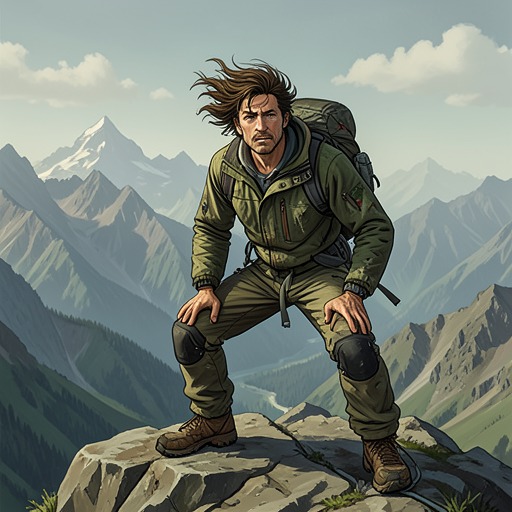
Anatoli Boukreev’s 1995 Dhaulagiri speed ascent
The ClimbAnatoli Boukreev’s 1995 Dhaulagiri speed ascent was a solo, oxygen-free summit push that took seventeen hours and fifteen minutes, an unplanned record that made visible both his exceptional high-altitude capacity and the changing, increasingly self-financed conditions of post-Soviet mountaineering.
An invitation under new conditions
The Georgian team invited Boukreev to join its planned attempt on Dhaulagiri, an 8,167-meter peak, because it recognized his experience and the contribution he could make. But the invitation came with a financial condition: he had to cover his own expenses and his proportional share of the permit fee charged by the Nepalese government. With the end of Soviet state support, the climber could no longer assume the expedition would absorb his costs. Despite limited personal resources, he accepted.
The arrangement also reflected national pride and politics. The Georgians worried that Boukreev’s presence might be misunderstood and diminish the public impact of a team success, since he was Russian and lived in Kazakhstan. They agreed that he would climb with them until the final summit push, then proceed separately. The separation was not presented simply as rivalry between individual climbers; it was a way to ensure that any successful ascent would not appear dependent on a Russian climber’s expertise.
The solo summit push
On October 8, 1995, Boukreev made the final push alone and without supplementary oxygen. The resulting ascent took seventeen hours and fifteen minutes. He did not set out to establish a speed record; the record emerged from the time he took to reach the summit. Its unplanned character matters: the achievement was not described as the outcome of a formal record attempt, but as a consequence of Boukreev’s actual pace on the climb.
Return and professional consequences
Boukreev returned to Kathmandu on October 20 and immediately resumed looking for work. He continued discussions with Henry Todd of Himalayan Guides, who had made him a verbal job offer. Their professional connection already had a practical basis: in May 1995, Boukreev had guided Todd’s successful expedition on Everest’s north side while Todd recovered from a back injury in Base Camp. After Boukreev’s Dhaulagiri success, Todd was eager to secure his services for the 1996 season, when he planned an expedition on Everest’s south side by the Southeast Ridge route.
The climb thus belongs to a period in which athletic achievement and paid guiding work were closely linked. Boukreev’s summit push demonstrated his capacity on a major Himalayan peak, while his return to Kathmandu brought him directly back to the search for the next expedition and employment. The route from a privately financed invitation to a prospective guiding position captures the material pressures surrounding the ascent as well as its mountaineering distinction.